Showing posts with label deforestation. Show all posts

Thursday, September 27, 2012

Deforestation 2012 quick facts


It is estimated that in 2012 deforestation should account for approximately 12% of global greenhouse gas emissions. As in previous years, most deforestation in 2012 took place in tropical rainforests.

The newest joint scientific work including Canadian and Dutch scientists says that the biggest cause of global deforestation is agriculture, which is responsible for approximately 80% of worldwide deforestation. The best example is Brazil where agriculture is actually the cause of almost all deforestation in Brazil, with 750,000 km² of forest being already gone, and 80% of previous forest being converted into grazing land for cattle.

The scientists estimate that global tropical deforestation will release 1.1 billion tons of carbon dioxide into the atmosphere in 2012.

The Amazon rainforest still produces the most worrying effects of deforestation. This is because Amazon rainforest is the largest rainforest in the world, which plays key role in proper functioning of Earth's hydrological and climatological system.

The deforestation in Amazon isn't stopping because farmers continue to chop trees (slash and burn technique) in order to make room for their farms.

In the 2012, as well as throughout this last decade, two countries – Brazil and Indonesia were responsible for more than 50% of total greenhouse gas emissions from tropical deforestation.

The 2012 study by the UK scientists from Leeds says that deforestation leads to serious decrease in rainfall. They have calculated that the destruction of tropical forests would reduce rainfall across the Amazon basin by 21% in the dry season by 2050.

Our rainforests are major carbon sinkers. The 2012 study from U.S. scientists at Boston University says that tropical vegetation contains 21 percent more carbon than previously thought.

Thursday, March 29, 2012

How to reduce global deforestation?

Reducing global deforestation is very important because of several different reasons. As many of you already know deforestation is big environmental issue in many tropical rainforests.

Tropical rainforests are not only areas of richest biodiversity on our planet but they also sink carbon from the atmosphere and therefore help reduce the global climate change impact.

The scientists have calculated that deforestation accounts for approximately 12% of global greenhouse gas emissions which is a significant percentage. Since most deforestation occurs in tropical rainforests world needs to reduce clearing of these forests in order to reduce total level of greenhouse gas emissions.

 Most tropical forests are located in developing countries and reducing poverty in these countries is definitely one of the best solutions to reduce global deforestation level. Why? Because the people that are involved in illegal logging are more interested in short-term profit than allowing the forest to remain.

Developed countries need to do lot more to protect tropical rainforests and one of the proposed solutions is that tropical countries get paid by developed countries if they retain or increase their tropical forests cover.

How much should tropical countries be paid for the retention of forests and what is the best mechanism to determine the total level of retention? The scientists believe that the solution lies in measuring the amount of carbon contained in natural forests. These measurements would be the perfect foundation for tropical countries to receive compensation from developed countries.

The protection of rainforests is also an important part of international climate talks, and for a new climate deal in which issues relating to the measurement of carbon in forests and soil are very high on the agenda.

Thursday, November 24, 2011

Interesting facts about deforestation

It has been estimated that the world's remaining forests are disappearing at an annual rate of more than 32 million acres.

The world's largest rainforest – the Amazon rainforests is in great danger because of the ever-increasing production of soybean and biofuel crops in Brazil which accounts for higher deforestation rates.

According to researchers from the Stony Brook University cocaine production in Colombia is having increased impact on country's deforestation rates because cultivating coca bushes is speeding up destruction of rainforests.

Increased export of Brazilian beef is one of the main reasons for excessive deforestation in the Amazon. It has been estimated that 60-70 per cent of the deforested land is used for cattle ranching mainly by farmers establishing small-scale farms.

The forests absorb approximately one third of fossil fuel emissions (approximately 2.4 billion tonnes of carbon per year from the atmosphere) which means that global deforestation must be stopped in order to have a decent chance to tackle climate change.

The deforestation in Amazon is far more than a regional problem, it is a global issue because Amazon rainforest makes up a key part of Earth's hydrological and climatological system and has a significant impact on global climate.

The deforestation rates in Amazon have been steadily decreasing over the last 6 years, in fact according to the UK scientists the global CO2 emissions from deforestation have decreased by over 25% since 2000 compared to the 1990s levels, mostly because of reduced CO2 emissions from tropical deforestation. Still, deforestation and forest degradation currently accounts for 15 to 20 percent of global carbon emissions

Deforestation has the potential to alter evaporation patterns in a region, potentially affecting water resources in distant regions. This is because forest floors are mainly responsible for evaporation in forests. Removal of forests does not only reduce the evaporation from the trees, but also reduces the evaporation from the forest floor. The result of this is a local decrease of evaporation which can lead to serious consequences for rainfall, water resources and even global food security.

In order to successfully tackle deforestation at global level world needs international bodies that would among other things ensure adequate forest monitoring and enable internationally managed deforestation in order to minimize the environmental damage caused by converting forests to agriculture.

Deforestation could become one of the key factors in global biodiversity loss because most of our planet's terrestrial biodiversity is contained in tropical rainforests.

Thursday, September 22, 2011

How to ensure sustainable forest management?

Sustainable forest management is one of the prerequisites for our future wellbeing. Why? Because forests are areas with rich biodiversity that provide us with services and goods on which our wellbeing depends upon. Forests help regulate climate, supply health, energy and livelihood to our society.

Even despite the enormous importance of our forests thousands of hectares of forest are lost each year. Deforestation is the worst in Indonesia and Africa where tropical rainforests are disappearing at an alarming rate.

Our forests, especially rainforests, are together with our oceans the most important carbon sinkers, therefore very helpful in reducing the total climate change impact. The forest loss around the globe does not only mean less absorbed carbon emissions but is also releasing billions of tonnes of CO2 into the atmosphere.

Current forest conservation efforts haven't been very successful and world needs to find quick solution(s) to preserve forests for our future generations. Among the proposed solutions are establishing more protected areas such as national and state parks, ensure better land-use planning and improve the current management of protected areas.

In order to give positive results all these solutions need big funding. By big funds I mean the tens of billions of dollars in the next decade because without such large funds we won't be able to halt the current forest loss.

The question that raises itself is how to ensure such a large-scale financing? The WWF believes that the solution for this may lie in forest bonds. Don Kanak, Advisor to WWF's Forest and Climate Initiative said that "we can't wait until the last tree has fallen to find this large-scale of finance. Forest bonds may be a promising way to close that short-term gap in financing so our forests don't slip away while we sort out how we're going to fund their long-term conservation."

The form of financing isn't as relevant as financing itself - the most important thing is to obtain the money for forests conservation, regardless of the finance tools used in the process.

Our forests need to be preserved at any cost. World has to do anything in its power to save the forest from disappearing. Our future may well depend on it.

Thursday, September 15, 2011

Palm oil plantations could threaten Africa’s biodiversity

The large palm oil plantations have already caused huge environmental destruction in Indonesia, mostly in form of massive deforestation. The same scenario could soon happen in Africa after a New York-based agricultural firm Herakles Farms announced its plan for a massive palm oil plantation (148,000 acres) in Cameroon.

This big palm oil plantation should be built in one of the Africa's most biodiverse areas, amid four protected areas, including Korup National Park, Rumpi Hills Forest Reserve, Bakossi National Park, and Banyang Mbo Wildlife Sanctuary.

An expected massive deforestation in this area will create irreparable damage to wildlife in this area and many animals will find it very hard to survive. This area already gives home to some of the endangered species including red-eared guenon, Preuss’s red colobus, the drill, and the Nigeria-Cameroon chimpanzee.

The conservationists also fear that the increased economic activity in this area will cause more people to migrate to this region, causing rapid boom in population, meaning that there won't be enough available space for both people and wildlife.

The bushmeat trade is already a big issue in this area and with more workers coming to this area this problem could become even worse.

If this plantation gets the final go ahead by Cameroon government it will disrupt important wildlife migration routes and isolate wildlife populations by preventing their interconnection. The Herakles did however say that it is considering creating wildlife corridors but with more people coming in this area something it will be almost impossible to achieve this.

There is no doubt that this huge oil plantation would cause significant economic benefits in this area, particularly in form of new jobs for poor African people. The Heracles already mentioned the number of 9.000 new jobs.

However, even the positive economic prospect isn't enough for many people in this area to support this new palm oil plantation because they (rightfully) fear that this could mean losing their forests, not to mention being surrounded by oil palms or in some cases even being forced to relocate.

Developing a sustainable and environmentally friendly oil industry in Africa isn't as easy to do as Bruce Wrobel, president & CEO of Herakles Capital thinks it is. Even the positive social ambitions for better economic prosperity aren't enough to justify potentially irreparable damage to Africa's rich biodiversity.

Sunday, February 27, 2011

Deforestation still a huge problem for Indonesia

The rates of deforestation in Indonesia are still a major environmental issue because according to the latest study by the South Dakota State University forest cover loss at Kalimantan and Sumatra was 5.4 million hectares, or 9.2 percent, of their total forest cover between 2000/2001 and 2007/2008.

The Indonesia's laws that protect forests from deforestation are still pretty much inadequate because more than 20 percent of total deforestation in Indonesia occurred in areas where deforestation was either restricted or prohibited.

The main reason why so many forests are being destroyed in Indonesia is the creation of pulp and paper plantations and oil palm estates. Losing so many forests doesn't mean only huge environmental loss for Indonesia, it also accounts for huge economic damage. According to the data from Indonesian Corruption Watch the total losses from deforestation in Indonesia were at $8 billion between 2005 and 2009, or in average $1.6 billion per year.

Huge deforestation is also the main reason for Indonesia's growth in greenhouse gas emissions over the last ten years. Indonesia has become aware of the fact that the only way to reduce greenhouse gas emissions is to stop deforestation, and Indonesian President Yudhoyono in 2009 announced Indonesia would cut greenhouse gas emissions by 26-41 percent from a projected 2020 baseline, provided it would receive international help.

The Norway has responded to this, and has signed a 'REDD+' (Reducing Emissions from Deforestation and Degradation) partnership with Indonesia under which Indonesia could generate up to $1 billion if being able to meet its deforestation reduction targets.

Stopping deforestation will be anything but easy for Indonesia's government not only because of pulp, paper, and palm oil plantations but also because of the traditional corruption problem which significantly undermines the significance of forestry laws in Indonesia.

Sunday, May 16, 2010

How can forests protect us from climate change?

Forests, especially rainforests are together with oceans our main allies against climate change because they absorb large quantities of CO2 from the atmosphere. Therefore, world must do everything that's necessary to stop deforestation of rainforests, especially Amazon rainforest because if we lose our rainforests climate change impact will be much stronger, and temperatures will rise much faster.

Amazon rainforest is the biggest rainforest in the world and its deforestation contributes to around 75% of total Brazilian greenhouse gas emissions.

Climate change impact is likely to grow over time, and this could lead to frequent wildfires that could destroy many forests and rainforests, and lead to many animal deaths.

Old tropical rainforests absorb most carbon dioxide from the atmosphere. The big reason for worry is that these ancient forests are disappearing very fast (Amazon, Indonesia and Congo).

Forest funding where rich countries pay poor countries to conserve their forests and rainforests is one of the best solutions to save our forests and rainforests.

In fight against climate change it is of vital importance to reduce current deforestation rates. On global level deforestation causes one fifth of total world's greenhouse emissions.

Many recent studies have confirmed that tropical rainforests now absorb more carbon emission than they did couple of decades ago but we still can't count on them to continue to offset our carbon emissions in the future. They can only give us a bit more time to tackle climate change.Forests use carbon dioxide as building blocks for organic molecules and store it in woody tissues but that process doesn't last for eternity.

Planting new trees as well as protecting the old trees can help reduce carbon emissions from the atmosphere. Some recent studies have confirmed that tropical forests are very efficient at keeping the Earth at a stable, healthy temperature.

Wednesday, January 6, 2010

Amazon rainforest deforestation - The main causes

Forests, particularly rainforests play extremely important role in our planet. The largest rainforest on our planet is Amazon rainforest that covers area of five and a half million square kilometers (1.4 billion acres) which is more than half of remaining rainforests on our planet. Once long time ago rainforests covered 14% of the earth's land surface while now they cover just 6%. Many experts agree that if current trends of deforestation are about to continue in years to come we could lose all of our rainforests by the end of this century. This would be a real tragedy, and life would be much more difficult without the rainforests.

First of all climate change impact would be much stronger because forests and rainforests absorb large quantities of CO2 (carbon dioxide). CO2 is harmful greenhouse gas mostly responsible for global warming and climate change, and without rainforests lot more of this gas would end up in the atmosphere causing even bigger global warming impact. So as you can see forests are one of nature's defense systems against climate change problem. This is arguably their most important role but definitely not the only role they know how to play.

Forests also have tremendous impact on climate itself by regulating temperature, they produce several important nutritients like nitrogen and phosphor. Rainforests are also the areas of richest biodiversity on our planet with thousands of endemic animals and plants that are unique to them. There are many scientists that believe how rainforests could be also hiding cures for currently incurable diseases (Aids) because of thousands of plants that are still undiscovered. Some estimates even say that we are losing 137 plant species every single day due to rainforest deforestation. One of this plant species could easily be cure for some nasty disease but sadly we will never know was it or not.


Tropical rainforests are home to many unique plants. One of these plants could perhaps turn out to be cure for aids or some other currently incurable diseases.

Just imagine these tropical rainforests that stood for millions of years are being cleared each day by chainsaws, bulldozers and fires. We are destroying in a blink of an eye something that was created for many millions of years. How big is deforestation in Amazon? In the last 40 years Brazil (60 % of total Amazon rainforest) lost more than 600,000 sq km (232 000 sq miles) of Amazon rainforest, and the worst deforestation years were between 1991 and 2000 when the total area of forest lost in the Amazon rose from 415,000 to 587,000 km2

Why is Amazon rainforests being so heavily destroyed? Main cause for Amazon rainforest deforestation is definitely clearing forest area for cattle pasture. This most important reason of deforestation in Amazon rainforest caused deforestation of seventy percent of formerly forested land in the Amazon, and 91% of land deforested since 1970, is used for cattle pasture. Human population is constantly growing, needing more and more food, and this is where big profits play their role. Cattle breeding is traditional business in Brazil that gives nice profits (especially since meat prices are constantly rising), and what is equally important it doesn't require big maintenance expenditures. What it requires though is large area, and Amazon rainforest is the one that stands in the way of high profit. As in many other cases too, environment and ecology are much less important than economy and high profits and rainforests are being cleared out. Cleaning forest area for cattle pasture causes somewhere around 60-70 % of total deforestation, and is by far the biggest cause for tremendous deforestation in Amazon rainforest. Areas, once full of trees are now savannas and other coarse grasses needed for cattle pasture.


Cattle pasture is the main cause of deforestation in Amazon rainforest

When Amazon rainforests isn't making room for savannas and cattle, it is making room for new farms. Population in Brazil and other South American countries is constantly increasing, and since we are talking here about traditional countries mostly oriented on agriculture it is no surprise that large areas of forests are being cleared to make rooms for new farms. Poverty is still very much present in Brazil and government in many cases stimulates poor population to settle in these areas by creating new farms. Farmers mostly use fire for clearing forests, and this is the most negative thing in whole deforestation story. Not only does this mean that large areas of forests are being destroyed, this also means that many CO2 gets released in atmosphere giving more impact to climate change. According to scientists deforestation is second most important cause for global warming phenomenon, responsible for more than 20 % of total CO2 emissions.

Farms are in most cases soybean farms, especially after biofuels were discovered. Of course profits are once again very high, in fact profits are so high that Brazil has more than remarkable growth in soybean production, so big that is only matter of day before Brazil becomes No. 1 soybean producer, and overtakes U.S. as the main producer. Farms are responsible for about 20 % of total Amazon rainforest deforestation but this percentage is steadily growing in last couple of years driven by higher food prices and bigger profits.

Next cause for excessive Amazon rainforest deforestation is logging. People often mistake logging as the biggest cause of deforestation but this is far from truth. In reality logging is causing only 3-4 % of total deforestation. However even this percentage, though it seems small, it is still not negligible. Tropical rainforests are excellent sources of many quality and expensive wood (ebony), and this is the reason why many people turn to illegal logging as highly profitable business. Illegal logging is still big problem in Brazil, and there is still not adequate control that would put an end to a steady rise in illegal logging. Brazilian government still fails to take serious actions against illegal loggers, and the longer the government delays serious action the more Amazon rainforest gets cleared.
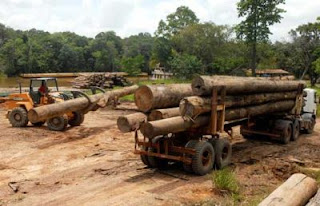

Logging is causing only 3-4 % of total deforestation in Amazon rainforest

Another reason responsible for destruction of Amazon rainforest is infrastructure building, responsible for about 3 % of total Amazon rainforest deforestation. The main problem with infrastructure building in Amazon is lack of sustainable management and good planning. The best example for this was building of infamous Trans-Amazonian Highway. Trans-Amazonian Highway had its purpose in not only connecting far places of the land, but also to open new areas for farms and easier exploit of quality woods. After this project was finished lack of sustainable management showed its full face, and deforestation took unprecedented level because now with available roads lot more forest areas become available for clearance.

When all this deforestation factors are summed up, the estimates say that the current rate of Amazon rainforest is so big that in two decades from now the Amazon rainforest will be reduced by 40%. If this is about to happen then this would probably be one of the biggest environmental disasters in history of our planet if not the biggest one. So we definitely need to prevent this from happening. But how to do this?

First of all rich countries should step in and ensure huge funds to stop deforestation. This money should be given to poor people that live in Amazon so they wouldn't need so many farms, and so many cattle to survive. Of course it is not enough to just collect money for this it is also important to make it sure that this money gets to the right people and not to end up in the pocket of some corrupted politician.

Another thing that should be definitely done is rehabilitation of formerly forested areas that are not longer interested to farmers. If only one small part of former ecosystem is saved this should be enough to start the rehabilitation. Also government needs to ensure more protected areas in Amazon rainforest. However in order for all of this to work farmers should really be more ecologically educated so they could understand the true importance of tropical rainforests. There are of course the laws. The laws are currently nor strict enough nor precise enough to stop the deforestation. Laws against deforestation need serious sentences to their offenders (jail sentences instead of fines), and government has to promote the importance of rainforests where ever and when ever possible. Unless people learn the importance of rainforests, profits will be always more important than Amazon rainforest. Money is not everything, and people have to realize this as soon as possible. Otherwise, not only survival of Amazon rainforest will be at stake but our own survival too.

Connection between deforestation and climate change - Quick facts

Forests play key role in fight against climate change because they absorb large quantities of CO2 from the atmosphere, especially rainforests. This is the reason why forests are sometimes called as "the nature answer to global warming".

As the climate change impact will increase in years to come so will the chance of wildfires and busfires that will become more frequent and powerful enough to destroy many of our forests.

Old tropical rainforests that are absorbing most CO2 are disappearing very fast. These ancient forests have big effect on overall climate.

Current rates of deforestation in many parts of the world are horrific and this gives additional boost to already serious climate change problem.

Tropical rainforests are home of many unique species, and areas with the richest biodiversity in the world. If they are destroyed, global warming effect will be far more powerful, and many species will go extinct.

Amazon rainforest is the biggest rainforest in the world. Deforestation of Amazon rainforest contributes to 75% of total Brazilian greenhouse gas emissions.

Forest funding should be much more used in order to prevent deforestation in developing countries because forests play key role in fight against global warming.

Deforestation on global level causes one fifth of total world's greenhouse emissions. The more forest we lose the less CO2 remains in the atmosphere.

Forest funding is not enough without the funding control of where exactly do these funds end. Only then forest funding can make the difference in forest preservation.

Sunday, November 15, 2009

Deforestation in Brazil finally slowing down

Deforestation in Brazil looks to be slowing down, in fact Brazil has announced a reduction in Amazon deforestation to its lowest level since the 1980s, as the result of excellent government strategy that included measures such as improvement of real time satellite monitoring, and proper enforcement that allowed forest rangers to go directly to areas where logging or burning was taking place.

Official government figures say that around 7,008 square kilometers of trees were cut down in the year to July, which is massive 45.7 per cent decrease on the previous year's figure and just a quarter of the 2004 deforestation level. President of Brazil Luiz Inacio Lula da Silva proudly said how "this latest data shows "an extraordinary and significant reduction for Brazil".


Deforestation in Brazil looks to be finally slowing down.

This decrease in deforestation is of vital importance in country's efforts to reduce CO2 emissions because deforestation is the largest cause of deforestation in Brazil. If this trend is about to continue than Brazil's promise that it will make the voluntary reductions of between 38 and 42 percent in its carbon dioxide emissions really does not seem too optimistic like many thought it does.

The government in Brazil is certainly putting lately lot more effort to protect Amazon rainforest than it used to have. Today 43 percent of the Amazon is under state protection, with many land being turned into reserves or national parks and with sustainable logging initiatives and programs that pay people to protect rather than cut down trees in Amazon rainforest deforestation rates are slowing down.

Hopefully we'll see this positive trend in years to come too.

Thursday, November 12, 2009

The negative effects of deforestation

Ruthlessly destroying forests and rainforests around the globe to make more room for farms and cattle pasture is one of the biggest environmental evils that happens today in many parts of the world. Since the start of the industrial revolution mankind has destroyed almost 40% of its forests and rainforest, doing great damage to different forest ecosystems around the globe. Current deforestation rates in Amazon rainforest, Africa and Indonesia are alarming, and beautiful ancient rainforests keep disappearing from the face of our planet.

Forests and rainforests are being cleared for many different reasons, mostly because agriculture, cattle pasture, and industrial expansion. Togehter with forests many animals and plans that rely on them will also perish from face of the Earth. Rainforests for instance are areas of the richest biodiversity on our planet, and if we continue to destroy them many animals and plants will go extinct, incuding even some currently not known species that we wouldn't have to chance to study.

The negative effects of deforestation will not only stop with plants and animals facing extinction, it will also make climate change problem much worse than it already is. Together with oceans our forests, particularly rainforests are the largest carbon sinkers on this planet, helping regulate climate and temperature increase by sinking large quantities of carbon dioxide from the atmopshere. The more forests we destroy the less carbon will they sink, and to make irony even bigger by destroying them we usually emit large quantities of greenhouse gases into the atmosphere (burning).


Deforestation has many negative effects on environment. The two most negative effects of deforestation are climate change and extinction of species.

Despite these negative consequences of deforestation forests and rainforests are still being cleared in many parts of the world. The laws are still not strict enough to save forests and rainforests, and to make matters even worse tropical rainforests are mostly located in poor developing countries. As the population in these countries keep on growing people need more food to survive so they destroy forests to make room for farms and cattle pasture. In order to fix this poverty factor rich countries should ensure better forest funding that would give poor people enough money to survive without clearing forests.

Instead of cutting trees we should plant them because planting trees and afforestation activity helps in saving our planet, especially if it is done on global level. Sadly, global action to plant as many trees as possible hasn't still happen while deforestation rates keep on growing. Unless world does something really fast deforestation will create global environmental disaster in years to come.

Tuesday, October 27, 2009

Deforestation in Indonesia not stopping

Indonesia is world's third largest CO2 emitter, behind China and United States, and deforestation is the main cause for such excessive emissions. In the middle of the last century Indonesia was heavily covered with rainforest (about 80%), but in the last 50 years deforestation, mostly in form of logging and burning has destroyed half of Indonesia's forest cover.

As the Indonesian rainforest keeps disappearing at the alarming rate, this also shrinks habitats for many endangered animal species such as tigers, elephants and orangutans. In fact Indonesia is the fastest destroyer of the rainforest in the world, and Indonesian rainforest is disappearing even faster than Amazon rainforest. The facts that Indonesia loses in average two million hectares of rainforest each year should ring alarm not only in Indonesia but also in entire world.

Indonesia is also doing double damage to climate change, not only that Indonesia destroys rainforests that would otherwise absorb large quantities of CO2 but the destruction of forests accounts for 80 percent of the 2.3 billion tons of carbon dioxide emitted in the country per year.

Sadly deforestation in Indonesia looks very likely to continue in years to come too because of poor land management, lack of adequate laws, and heavy corruption. Logging and clearing of forests for agriculture and industrial plantations, including oil palms will destroy much more forest area in years to come, and create even bigger CO2 emissions, some estimates showed that Indonesian Co2 emissions will increase 57 percent from today's level.

The third largest rainforest in the world (behind Amazon and Congo rainforest) definitely deserves more protection, and international community should put more pressure on Indonesian government to introduce new measures that would halt deforestation in Indonesia.


Logging and burning have destroyed half of Indonesian rainforest in the last 50 years.


Monday, August 31, 2009

Building new roads means even bigger deforestation

The best solution to protect and save rainforests across the globe is to keep them away from people. But this is sadly not happening today, especially not in world's largest tropical rainforest, the Amazon rainforest, where more and more rainforest areas are exposed to people mostly because of tremendous road expansion. Ever-expanding roads are built throughout the heart of Amazon rainforest. The more roads there are the bigger threat this is for Amazon rainforest, and deforestation is likely to increase even further. Even now as I write this Brazil is already building a brand new 900-kilometre road (the BR-319) through largely pristine forest. This new road will open even more rich forest areas to loggers and farmers, and is very likely to result in massive deforestation.


Roads are constantly built throughout the heart of Amazon rainforest

Environmentalists are constantly describing roads as one of the biggest evils for rainforests across the globe but this has very little or almost no effect because politicians are making the decisions, usually based on some interests from some powerful lobbies, instead looking at things from environmental point of view. Every new road that is built means destruction of one ancient and beautiful piece of nature, but not only this, every road opens door for further destruction of rainforests, one of nature's most beautiful monuments. Rainforests are not only beautiful pieces of nature, they play far more important role in regulating climate on our planet, which is extremely important, especially now when climate change problem threatens are way of life. But still we do not care enough to protect our rainforests, and instead of becoming nature allies we are sadly becoming biggest threat to nature. And biggest threat to ourselves too.

Saturday, June 20, 2009

Deforestation in Africa - Uganda

All recent studies show that deforestation is worst in Africa. Deforestation is among the biggest ecological problems in Africa, and one of the areas worst hit with deforestation is the east African country Uganda. Latest study showed that in less than 20 years time (since 1990) Uganda lost one third of its forest cover. In the beginning of 90s Uganda had more than five million hectares of forest cover but in less than 15 years time (by 2005) Uganda lost more than 1,5 million hectares of forests.

The main reason for such huge deforestation is the same like in many other African countries, namely the rapid grow of human population. As the population grows humans need more room for their farms and following infrastructure, and forests are cleared to make the necessary space. If by any chance Uganda's government fails to stop this excessive deforestation Uganda will be forest-free by 2050.

Many of you probably know that Uganda is one of the poorest African countries with mostly rural population. This African country is so poor that only 10 percent of its population has access to electricity while remaining population depends upon firewood for cooking needs. Increased Ugandan population is heavily clearing remaining forests because they practically need wood to survive. There are more than 31 million people living in Uganda so this mean that more than 25 million people need firewood for cooking, and if you add to this the fact that Uganda has one of the world's highest population growth rates you can clearly see how serious this deforestation problem really is.

The worst deforestation in Uganda is happening around the capital city Kampala. People want to be as close as possible to Kampala which has resulted in the expansion of built-up areas in near Kampala. This expansion in urbanization has caused area around Kampala to lose more than three quarters of its forests in the last 20 years, and if this continues area around Kampala will soon be forest-free.

Deforestation in Africa is not only ecological problem but also very important political question that rich countries will need to answer very soon. Africa is not capable to protect its forests without the aid from rich countries, and rich countries should really ensure much more funds for Africa. Unless this happens poor African people will be forced to continue with further destruction of their forests because this is the only way for them to survive.

Thursday, June 11, 2009

Deforestation - Definition and meaning

What is deforestation? The most simple definition would be cutting down trees in forests and rainforests so this is really a form of forest destruction that is usually done by logging and/or burning of trees. Why are people clearing so many forests and rainforests around the globe? The biggest factors that contribute to deforestation are farms and cattle pasture. In many countries of the developing world population is growing, and as the population grows people need more and more room to expand so many forests are cleared out, and on once forested areas now are mostly farms and savannas.

The biggest reason for concern are old tropical rainforests that are disappearing really fast. These ancient forests absorb large quantities of CO2 which not only regulates climate but also helps in slowing the global warming impact. Rainforests and forests are not only important because of their role in climate they are also areas of extremely rich biodiversity with lots of unique plants and animals that need forests to survive.

Deforestation is also giving significant impact to climate change problem. The more forests disappear the less carbon emissions they sink but what is even worse is often use of slash and burn techniques. By using slash and burn techniques we are constantly releasing huge CO2 emissions in the atmosphere. Industry and cars are not alone as leading causes of global warming, one major factor is also deforestation. One study showed that in just 24 hours time deforestation will release as much CO2 into the atmosphere as 8 million people flying from London to New York.


Deforestation has reached an alarming rate in many countries around the world but three areas hit the most by deforestation are Amazon rainforest, Africa, and Indonesia. In these three areas condition is really no longer alarming, it is really already in critical zone. Deforestation is really one of the biggest environmental evils that happen on this planet, and if current trend continues with somewhere around 16 million hectares of forests disappearing each year, our planet will head into a real environmental disaster in years to come.

About half of the forests that once covered the earth are already gone, and we are definitely not doing enough to protect the ones that remain. Our forests and rainforests mean so much to us but most people still do not understand how important forests really are. What we definitely need is some very quick solution to stop deforestation. Will this solution turn out to be forest funding, or something else it really doesn't really matter. As long the forests are saved.

Thursday, March 26, 2009

Why is important to stop deforestation?

Deforestation is today without a doubt one of the biggest ecological problems. In many parts of the world forests are being cleared to make room for farms and different other agriculture projects. Since many see this year as the one that could make all the difference in fight against global warming it is of vital importance to raise public awareness about deforestation because deforestation is responsible for about 20% of total CO2 emissions from human activities.

Deforestation issue should really be one of the key issues in December this year when world leaders will try to agree on international climate pact. It is very clear that world needs to drastically reduce greenhouse gas emissions, and stopping deforestation is one of the factors that will seal the destiny of this new pact. Using less fossil fuels and stopping deforestation are key factors that will mean the difference between success and failure.

Why are forests being so heavily cleared worldwide? Why has deforestation become such a big problem? The reason for this has lot to do with big population increase. More people need more food, and in order to get more food forests are being cleared out to make room for farms. Farms also mean bigger profit because for example converting tropical forests to lets say soya beans farm means lot more money than managing forests in sustainable way.

But it is not all in the money, well at least it shouldn't be, and world should finally realize the importance of our forests. Forests are vital parts of our planet and we should do all what is in our powers to protect them, especially now when climate change problem is knocking on our door. Public awareness is important step but it won't be enough without the funding from rich countries, because most forests are located in developing countries that need to act in the much broader interest because health of our planet is at stake here. Only combination of public awareness, sufficient funding and sustainable management can save our forests. Are we up to this task? We'll soon see.

Tuesday, March 17, 2009

Deforestation - One of the biggest ecological problems

Forests, especially rainforests are not only home to many unique animals and plants but they also protect us from stronger global warming impact by absorbing carbon dioxide from atmosphere. Deforestation has become big problem around the globe because many forests are being cleared to make room for new farms, and less trees means more impact to global warming and climate change. Not only this, deforestation is also responsible for about 20% of total CO2 emissions from human activities. To save our planet we definitely need to save our forests.

Current rates of deforestation are alarming in many parts of the world, and if this trend continues many forests and rainforests will vanish by the end of this century. Millions hectares of forests are being cleared annually, and deforestation is with no doubt one of the biggest ecological problems world is facing today. Rainforests have the richest biodiversity on our planet, but if current rates of deforestation continue many animals and plants will perish from existence. Just imagine, in less than 100 years we could destroy what nature was developing for millions of years. What an irony this would be...

The problem of climate change is also connected with forests and deforestation. Deforestation is responsible for 20% of total CO2 emissions, and if world really plans to drastically reduce greenhouse gas emissions, deforestation will have to be stopped immediately. Forests have natural ability to act as a carbon sink and can slow down increase of CO2 emission into the atmosphere which can be our strong weapon against global warming. The more forests remain the stronger we are in fight against global warming.

Sadly, many people around the world are still unaware of how important forests really are despite the climate change problem knocking on our door. Many people still do not care whether we'll protect our forests and stop deforestation or not. Public awareness is still not on sufficient level, and this has to change as soon as possible. World needs to hear sad truth about our forests and do everything to stop deforestation. Without our forests, our defense against global warming and climate change will be completely broken. It is really time to wake up from this nightmare, and do everything that is in our power to secure sweet dreams for our future generations.

This video below will give you other additional facts and statistics about the sad reality of deforestation.


Tuesday, November 18, 2008

Indonesia - Major deforestation problem

Indonesia was at the beginning of the past century densely forested country with forests covering about 85 % of country's area. The rate of deforestation wasn't that worrying all the way to 1970s, and it really started becoming major problem in 1980s rising to about 1 million ha per year, and after 1996 deforestation rate became even more critical with the rate of over 2 million ha per year.
What were causes of such excessive deforestation in Indonesia? First of all Indonesia has already a long history of corrupt political and economic system that regards natural resources only as a source of revenue, mainly for political purposes and of course personal gains.

Forests have helped Indonesia achieve significant economic boom in 1980s and 1990s mostly because of excessive growth in forest-related industry, especially pulp and paper production, where Indonesia is still one of the top world's producers. Industrial timber plantations were seen everywhere, and sustainable development nowhere, and there was of course corrupt political system that even encouraged illegal logging, because of high profits for everyone involved. Lets take president Suharto for instance who appropriated forest resources and afterwards divided them between his family and business partners, this should give you clear picture about the "sustainable development" in Indonesia.


Deforestation has taken critical proportions in Indonesia

Deforestation is till taking heavy toll in Indonesia, and Indonesia is mostly because of deforestation (85% of total emissions) third largest greenhouse gas emitter in the world. Deforestation is the most serious in lush lowlands on island Java. There is great irony that although so many forest have been destroyed in the last 30 years or so, many people in Indonesia still live in poverty, mainly because only few chosen ones were able to cash in on deforestation.

After the overthrow of infamous president Suharto Indonesia has taken first serious steps that should halt deforestation rate, and preserve remaining forests. But this transition hasn't gone very well because corruption heritage is still embedded in Indonesia political structure, especially at regional levels. Without adequate international support Indonesia will lose battle against deforestation. And preventing deforestation worldwide is the first big step countries must make to fight against global warming. Indonesia would make an excellent starting point.

Tuesday, September 30, 2008

Amazon rainforest deforestation not slowing down

Despite (alleged) efforts on local and international level Amazon rainforest is still being heavily destroyed. The latest report (29th September 2008) issued by Brazilian officials said that the Amazon is being deforested more than twice as fast as last year, which is huge disappointment after three ears of declines in the deforestation rate.

This alarming news is mainly the result of increased food prices that are stimulating soy farmers and cattle ranchers to clear more forest area for farms and pastures. There is also the problem of local authorities in the Amazon region that do not want to see daily illegal logging just to get more votes on the next election.

Amazon deforestation in August 2008 jumped incredible 228 percent when compared to the same month a year ago, with more than 290 square miles of Amazon destroyed in August this year, compared to the about 90 square miles in August last year. But things could be even more worse as institute that uses satellite imagery to monitor illegal logging fears that even more rainforest has been destroyed because no information was available for about quarter of the Amazon covered by clouds during the tracking.


Amazon deforestation again on the rise. Amazon is being deforested more than twice as fast in 2008 as in 2007.

This news should really ring some bells that current efforts are simply not enough, and that there is still a lot of hard work in front of not only Brazilian government, but also in front of international community. Amazon rainforest is vital from many different reasons, and its preservation duty of the highest priority. And we are running short, both on time as well as forest.

Tuesday, September 16, 2008

Kenya - Deforestation a great threat

3,522,000 hectares of Kenya is under forest, which is 6,2 % of the country's area. Many of Kenya's forests are old forests rich with biodiversity and many unique ecosystems. However, this doesn't stop deforestation in this African country. In period between 1990 and 2005 Kenya lost 5 % of its forest cover which means that around 186,000 hectares of forests have been destroyed. Main cause for such rapid deforestation is increased population that needs more land for agriculture.

But not all forests are being chopped to make room for farms, there are other reasons too, especially in time of droughts. What people look in times like this is alternatives to survive, often by transforming wood into charcoal or selling it as timber. For instance in the Mount Kenya forest reserve, 2,465 charcoal kilns were discovered by the Kenya Wildlife Service in an aerial survey in August 1999.

What people don't know is the fact that close canopy forests have a crucial role as water catchments which means that if the current rate of deforestation continues, there will be much more flood during the rainy season and droughts during the dry season. Destruction of these water catchment areas in various parts of the country is already beyond alarming, but yet it isn't showing signs of decrease.

There is of course rich biodiversity that also needs to be preserved. According to data from World Conservation Monitoring Centre Kenya has 1847 known species of amphibians, birds, mammals, and reptiles of which 4 % are endemic, and 3,8 % are threatened with extinction. Similar situation is also with plants of which 4,1 % are endemic with species like Olea africana and Dombea goetzenii.

So how the preserve Kenya's forests? One thing is sure Kenya can't achieve this alone, so international help is really necessary. Without enough food and water in Africa it will be difficult explaining African people why forests are so important, as their primary goal is survival. This is where rich countries should step in, primary with their money, but also with their knowledge. One thing that Kenya also desperately needs is much more learning facilities since existing ones are insufficient and cannot cope with the rising population pressure. Knowledge is also one of the keys needed for success.

But the biggest pressure should be on Kenya's government which needs to put much more efforts to protect forests. As the former Kenya's president Moi said: "You need to preserve the environment for the sake of future generations of this country". And he was spot on, because if the current rate of deforestation is about to continue in years to come, then future generations will have almost impossible conditions to live in.


Deforestation is big problem in Kenya